

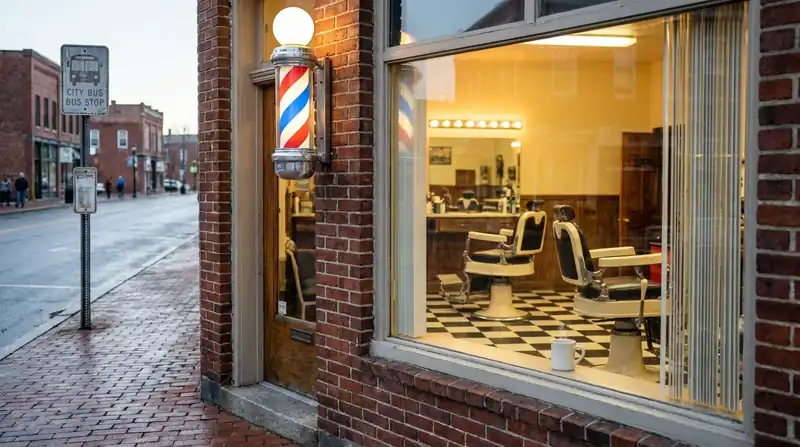
 Corner Seat · 7:03 a.m.
The Diner Mug on Chair No. 2, and the Customer Whose Name I Lost

A retired barber still drinks his coffee at 7:03 on the corner where he cut hair for forty-six years. The pouch his sister mailed, its two-line label, the honest research and the 30-day terms, read line by line.
On a Saturday morning last October, I stood behind chair No. 2 with a comb in my hand and could not tell you the name of the man sitting in it.
I knew the cowlick on the left side of his crown, the one that fights you on every cut.
I knew he takes a number two on the sides and leaves the top alone, and that his wife's name is Peg.
I knew he drove a beer truck for thirty years and that his dog is a beagle named Admiral.
The name of the man himself sat right there behind my teeth and would not come out.
So I said what barbers have said since the first striped pole went up on a corner: "What'll it be today, chief?"
He smiled and said "the usual, Vince," and I gave him the usual.
His name is Gene, Gene Polaski. It came back to me two hours later, on the bus home, somewhere around the stop by the hardware store.
I'm sixty-seven.
For forty-six years I cut hair on the corner of Seventh Avenue and Third Street, and in my trade the name is the first tool you pick up, before the comb.
So that minute behind the chair did not feel small to me.
A man who knew three thousand customers by name and by cowlick had just lost one of them, and he lost it to the tip of his tongue.
This is a column about a corner, a diner mug and the seven men who drink coffee with me at 7:03 every morning.
It's also about a pouch my sister mailed me from California, and what happened when I read it the way I'd read a new set of clippers.
If you've ever stood in front of somebody you've known for thirty years and waited for their name, you'll know most of this already.
You just haven't seen a barber write it down in his appointment book.
Forty-Six Years of Knowing Every Head on the Block
I opened the shop in the spring of 1978, with a loan from my uncle, two used chairs and a pole I bought from a barber in Steubenville who was retiring.
That pole is still on the corner.
For forty-six years I was the man behind chair No. 2. Chair No.
1 belonged to my partner Al until he passed, and then to whichever young barber I was training that decade.
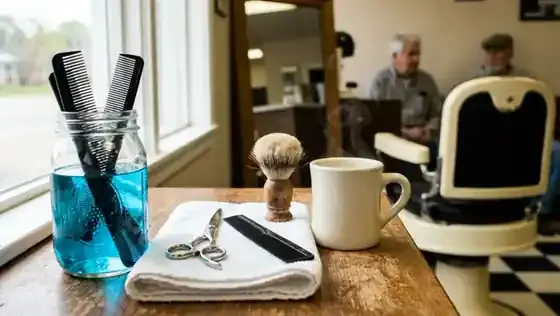
People think barbering is about hair. Hair is maybe a third of it, and the other two thirds is remembering.
You remember the name, the part, the clipper guard, and whether he likes the back squared or tapered.
You remember the wife, the kids, the bad knee, the bowling league and the brother-in-law nobody talks about.
On a good Saturday I'd do twenty-two heads before two o'clock, and I'd greet every one of them by name before he got his jacket off.
I'd know a man's haircut from across the street by the back of his head. I'd know his car by the sound of it parking.
A good barber keeps a whole neighborhood in his head, filed by cowlick. Nobody teaches you that in barber college;
you learn it the way you learn your own family's voices, by hearing them every day.
That's why Gene bothered me so much.
It wasn't a fact I'd misplaced; it was a member of the family sitting in my chair, and I couldn't say his name.
I retired in the spring of 2024 and sold the shop to Danny Reyes, who came to me at nineteen to sweep hair and stayed twenty-two years.
Danny runs it now, and on busy Saturdays I still pick up a comb at chair No. 2.
That's where Gene sat down. And that's where I started keeping the tally I'm about to show you.
The Small Misses I'd Been Filing Under "Getting Older"
Once Gene happened, I did what a barber does when a cut comes out lopsided. I went back over it, one pass at a time.
And honestly, the book had been showing me things for a couple of years that I'd been filing under age, or the weather, or Connie rearranging the kitchen.
The first entry was the keys. I've hung my keys on the same brass hook by the back door since 1983, and three times that summer they turned up somewhere else.
Once on the porch rail, once in my jacket, and once, I'm sorry to say, in the sugar canister. Connie found them when she went to sweeten her coffee.
The second entry was the comb. For forty-six years I've carried a black comb in my left shirt pocket, the way other men carry a pen.
In September I reached for it at the shop and found the pocket empty.
The comb was at home, in the mailbox, where I'd apparently set it down to read a seed catalog.
The third entry was Connie's list.
She wrote seven things on the back of an envelope, and I came home from the market with four of them and a bag of pistachios nobody asked for.
The fourth was the crossword. For twenty-five years I've done the Sunday puzzle in pen, sitting in chair No.
1 before the shop opens, and that fall I started doing it in pencil and leaving corners empty.
I'd have caught all four in a young barber in one morning.
A kid who loses his comb, his list and a regular's name in one season gets a talk from me at lunch, kindly, but a talk.
In my own life, I needed Gene Polaski to sit down in my chair and wait for his name before I'd look at the book.
What I Spent Before My Sister Mailed a Pouch
I want to be honest about the months before Angela's pouch, because columns like this usually skip that part.
A story that only lists what worked is a sales flyer in a barber's smock.
So here's the tally, with prices, the way I'd have written up a month at the shop that came in short.
Item one: two books of large-print crosswords, $12.98 for the pair. I did them in chair No. 1 every evening for a month.
I got very good at large-print crosswords. The keys still went into the sugar canister.
Item two: a phone app that promised daily "brain games" for $8.99 a month. It had a cartoon fox that told me I was on a streak.
I'm a grown man who once gave a straight-razor shave to a sitting congressman without nicking him. I cancelled the fox in the second month.
Item three: a talking pocket organizer, $29. The idea was to say things into it so I wouldn't lose them.
I lost the organizer. Connie found it in October, in the pocket of a coat I don't wear, and it held one message: me saying "pistachios" in a very serious voice.
Item four cost nothing at the register: more coffee. I'd read somewhere that coffee sharpens you up, so I went from two cups a day to five.
By the third week I was jumpy at the chair, my hands weren't steady on a neckline, and I was staring at the ceiling at one in the morning.
Connie said I was "vibrating," and she wasn't wrong.
Item five, the costly one, cost no money at all: I stopped going to the 7:03.
Too many names in one small room before eight o'clock, and I'd decided it was easier to stay home than to say "chief" six times before the shop opened.
That was the worst line on the whole tally.
When you skip the people so nobody sees you reach for a name, your world gets smaller one morning at a time.
Add it up and I'd spent about $80 in a season on things that didn't move anything, plus a few weeks of jittery hands and five weeks of mornings at the 7:03 I won't get back.
I tell you the number because I'd guess you have a number of your own, and you've never added it up either.
Seven Men, One Corner and a Bus That's Never Late
Every weekday, the first crosstown bus stops in front of the shop at 7:03. It has done that, give or take a minute, since before I opened.
Lou Bianchi drove that bus for twenty-eight years.
When he retired, he kept getting off it at 7:03, out of habit, and walking into my shop for coffee before I'd even flipped the sign.
Then the others started coming, one at a time, over about ten years.
By the time I sold the shop there were seven of us, and Danny keeps the coffee on for us at 7:03 the way I did.

I'll tell you about the seven, because a barber can't help himself, and because they turn up again later in this column in a way I didn't expect.
Lou, eighty-four, the bus driver, the oldest of us, with a face like weathered bark and a laugh you can hear across the street.
Sal, seventy-six, a retired mail carrier with a big shaggy white mane of hair he hasn't let me cut since 2009, out of pure stubbornness.
Walt, seventy-one, retired from the fire department, with a bald head that shines like a varnished banister.
Eddie, sixty-nine, a machinist, wiry and thin as a pipe cleaner, who's never once sat still for a whole cup.
Ray, seventy-three, who ran the newsstand on Third for forty years and still ruffles through four papers every morning like a hen fluffing her feathers.
Marty, seventy, the shoe repairman from next door, who has worn a striped sweater vest every day of his life, stripes like rings on a tree.
And me, the barber, the plainest of the bunch, the one you'd find on any corner in any town in America.
For years that was the best hour of my day. Seven men, one pot of coffee, four newspapers and fifty-five minutes of arguing about the Steelers before the first customer.
And for five weeks after Gene, I didn't go. I told the fellas my knee was acting up, which it does, but that wasn't the reason.
What a Cafeteria Manager Mails Her Little Brother
My sister Angela is seventy and lives in Glendale, California.
She ran the cafeteria at an elementary school there for thirty-one years, which means she fed, by her own count, something over a million lunches to children who mostly wanted the tater tots.
We talk every Sunday at four, her time one, my time four. In forty years we've missed maybe a dozen Sundays, and most of those were weddings.
In November I missed two Sundays in a row. She called Danny at the shop the following Tuesday, because Angela has never in her life waited for anybody to call her back.
Danny, who is a good kid and a terrible liar, told her I'd stopped coming to the 7:03. That evening she called me and asked straight out.
I told her what I'd told everybody: it's nothing, it's just the knee and the names.
There was a long pause on the line, the kind she used to give fourth-graders who swore they'd eaten their vegetables.
Then she said, slowly, as if she were reading a lunch count: "The names I believe, Vincent. The knee doesn't explain why you stopped going to coffee."
That sentence sat on the line between Pennsylvania and California for a long time after she hung up.
Nine days later a padded envelope arrived.
Inside was a pouch of instant coffee and an appointment card from my own shop, one of the old blue ones, with my sister's handwriting on the back.
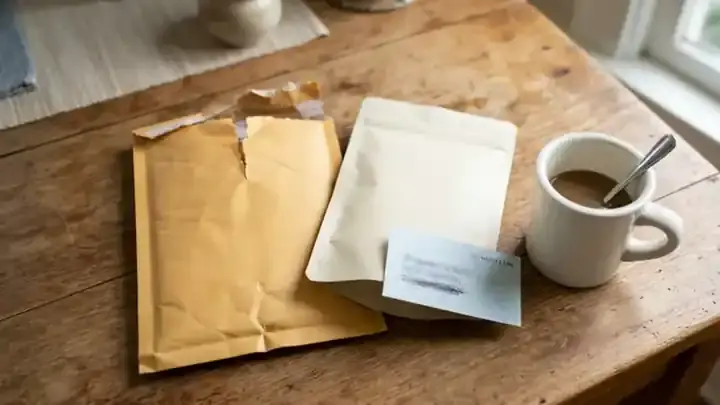
I read that card three times at the kitchen table. Then I did the barber's thing:
I put it in my shirt pocket, where the comb goes, and decided I'd check every line on that pouch before I let it anywhere near a mug.
Did the envelope come, or do I have to call the post office?
6:41It came. The card's in my shirt pocket until I've read the back of the pouch myself.
6:49Good, read it. And the 7:03 is tomorrow, in case you forgot that too.
6:50Very funny, I'll be there. Tell your grandson the Steelers send their regards.
6:52Why a Lunch Lady Changes the Cup, Not the Menu
That Thursday I went back to the 7:03, partly because Angela had earned it and partly because I wanted to call her afterward and cross-examine her.
"Why coffee?" I asked her, "when you've never bought me a cup of coffee in my life?"
Her answer was plainer than I expected. "Thirty-one years in a school cafeteria, Vincent, and here's the one thing I learned: you can't make a ten-year-old eat something new.
You can only change what's already on the tray. Kids drink milk every day, so you change the milk; you don't add a new food they'll throw away."
"You drink coffee every morning," she said, "so I didn't send you something to swallow; I sent you coffee. It's the same mug, the same teaspoon, the same seven o'clock."
She said she'd picked that particular pouch for a reason I understood right away:
"It's coffee and mushrooms, two lines on the back, and I could read the whole thing without my glasses."
And she'd looked it up, because Angela looks everything up. "The research on mushrooms is thin, Vincent, and I'm not going to pretend it isn't.
I'm telling you it's a decent cup of coffee you'd drink anyway, and a reason to walk down to that corner at seven in the morning instead of sitting in your kitchen."
I told Lou about it at the next 7:03.
Lou, who has an opinion on everything including the weather in other states, said that was the most sensible thing anybody had said in that shop since the 1992 strike.
I've thought about Angela's tray a great deal since then. She didn't promise me a thing, and she didn't use a single big word;
she changed the milk and told me to read the carton.
In my experience, people selling you something add to your plate; people who care about you change what's already on it.

The Pouch, Read the Way I'd Read a New Pair of Clippers
So here's what I did with the card, the way I'd have handled a new set of clippers from a salesman. I took the pouch to the shop, sat in chair No.
1 and read every line on it, front and back.
Then I went to the seller's own website and read every line there, too. I'll go through it in order, because order matters:
whatever a company prints biggest is what it wants you to see, and whatever it prints smallest is what you need to know.
The name. The front says ORGANIC mushroom COFFEE in big brown letters, and under it, in blue: "Instant Coffee With 7 Powerful Mushrooms."
It's made by La Republica Superfoods.
The company lists itself at Unit 355, Verdugo City, California, which is a little corner of the foothills next to Glendale, a few miles from Angela's kitchen.
The ingredient line. Two things, and I'll give them to you exactly as printed:
"USDA Organic Fair-Trade Arabica coffee, USDA Organic mushroom extracts (lion's mane, chaga, reishi, cordyceps, maitake, shiitake, and turkey tail)."
That's the whole list. There's no sugar, no creamer powder, no blend of eleven chemicals I'd need a dictionary for; it's coffee and seven mushrooms, in that order.
The serving: the Nutrition Facts panel says one teaspoon, two grams, makes eight fluid ounces.
The website says one teaspoon in six to eight ounces of hot water, stirred, with milk or creamer if you like.
The count. "35 servings" on the front of the pouch, and the photo on the listing shows a stand-up pouch of 2.5 ounces, which is 70 grams.
I'll mention one small thing here, because I promised to read every line.
The listing's written description talks about a reusable jar, but the photo shows a pouch, so don't be surprised by whichever one arrives at your door.
The numbers on the panel.
Seven calories a cup, zero fat, seven milligrams of sodium, one gram of carbohydrate (which is one gram of fiber), one gram of protein, and 73 milligrams of potassium.
That's a cup of black coffee, near enough. Whatever you put in it after, your cream and your sugar, is on your own panel.
What the panel doesn't print. Here's the line I'd circle in red: there's no amount for any of the seven mushrooms, and the listing for this pouch doesn't print a caffeine number.
The whole teaspoon weighs two grams, coffee included.
So the seven mushrooms together are some part of two grams, and the label doesn't say how much of each.
That's not unusual for a blend, and it's not a crime. But it matters a great deal when you get to the research, and I'll show you why in a minute.
How it's made, according to the seller. The listing says the mushrooms are "whole fruiting bodies," the part of the mushroom you'd see growing on a log, with no grain filler.
It says the extracts are made with water and alcohol, and that the coffee is shade-grown Fair-Trade Arabica from small farms.
I can't check a farm from my kitchen in Pennsylvania, so I'll pass that along as the seller's own words.
The small words on the front: across the top of the pouch it says "Full-Fruiting Bodies," "Antioxidants," "Adaptogens," "Low Acid" and "0g Sugar."
Along the bottom, each mushroom gets a little job title printed next to it.
I won't repeat those job titles here.
A word printed on a pouch isn't a study, and I'll tell you what the studies say instead, which is what the next section is for.
The line at the bottom of the listing. There, in small type, sits the standard sentence:
these statements haven't been evaluated by the Food and Drug Administration, and the product isn't meant to stand in for medical care.
I want to stop on that sentence, because most people's eyes slide right past it. It's the most honest line on any label, and it outranks every other line, including the name.

What the Studies Say About the Mushrooms, Shrugs Included
I spent four evenings at the Carnegie library on Ninth Street, and the reference desk pulled the journals for me without once asking why a barber wanted to read about mushrooms.
Here's what the file says, and I'm printing the shrugs in the same size type as everything else.
Start with the one mushroom in the pouch that has been studied for the tip of the tongue. That's lion's mane, the shaggy white one that looks like Sal's hair.
The study people quote most was done in Japan. Thirty-one healthy adults over fifty took 3.2 grams a day of a lion's mane fruiting-body preparation, or a placebo, for twelve weeks. [1]
A daily lion's mane fruiting-body preparation of 3.2 grams was associated with higher scores on a standard mental-status test compared with placebo.
— Saitsu Y. et al., Biomedical Research, 2019, Twelve-week trial of lion's mane in 31 healthy adults over 50[1]
The same paper reports that a test of visual recall did not change. [1]
I'll tell you what I like about that study.
It was done in people my age, it used the fruiting body, the same part the pouch says it uses, and it had a placebo group.
And I'll tell you what I'd circle: thirty-one people is fewer than I'd cut on a busy Saturday, and one test went up while another stayed where it was.
It's a reason to keep reading, not a reason to buy anything.
Now the amount, because this is where most articles go quiet. That study used 3.2 grams of lion's mane a day.
The whole teaspoon in Angela's pouch weighs two grams, and most of it is coffee.
You'd need more than a whole pouch-teaspoon of pure lion's mane, every day, just to reach the amount in that study, and this teaspoon is mostly coffee with six other mushrooms besides.
The second study is smaller in a different way. Forty-one healthy adults between eighteen and forty-five took a single 1.8-gram dose of lion's mane or a placebo. [2]
An hour later, the lion's mane group was faster on a color-and-word test that psychologists use to measure attention.
After twenty-eight days on the same supplement, the result on the other measure was only a trend that didn't hold up statistically. [2]
That's a pilot study, in young people, at a dose I can't match with a teaspoon of coffee, and the authors themselves asked for caution.
I'm putting it here with the fine print attached, so it arrives complete.
Then the other six mushrooms. I went looking for each of them, chaga, reishi, cordyceps, maitake, shiitake and turkey tail, and the question I care about:
the name on the tip of the tongue.
I didn't find a study on any of the six, about that question, that I could check and would put my name under.
So I'm not citing any, and I'm not going to pass along the little job titles printed on the pouch as if they were findings.
That's not a knock on mushrooms.
Shiitake and maitake are good food, and I've eaten them in Connie's soup for thirty years; it just means the file on them and the tip of the tongue is empty.
And then the part of the cup that surprised me most. The best-studied ingredient in the pouch isn't a mushroom at all; it's the coffee.
The European Food Safety Authority reviewed caffeine in 2015.
It concluded that caffeine in moderate amounts increases alertness and reduces sleepiness, and that up to 400 milligrams a day raises no safety concerns for healthy adults. [3]
A small British study gave twenty-seven volunteers a single dose of 50 milligrams of caffeine, with or without a tea compound, or a placebo.
On caffeine alone, people rated themselves more alert an hour later. [4]
I'll be careful with that.
"More alert after a cup of coffee" is something every man at the 7:03 could have told you without a study, and it isn't the same thing as finding a name.
But it's honest, it's measured, and it's the one line in my whole file that comes with real numbers behind it.
It tells me what's actually working in that mug at seven in the morning: the coffee and the company.
So here's the whole file, written the way I'd sum up a month at the shop.
One mushroom with two small studies at amounts a teaspoon can't reach, six with nothing on this question, a cup of coffee with real research behind it, and no study on this pouch.
That's not a wonder. It's not a nothing, either;
it's an honest cup of coffee with a short label, from a company that prints its phone number and doesn't pretend to be medicine.
And for a man who needed a reason to walk back down to the corner at 7:03, an honest cup of coffee turned out to be enough.
Seven Mushrooms, Seven Regulars, and No Job Titles
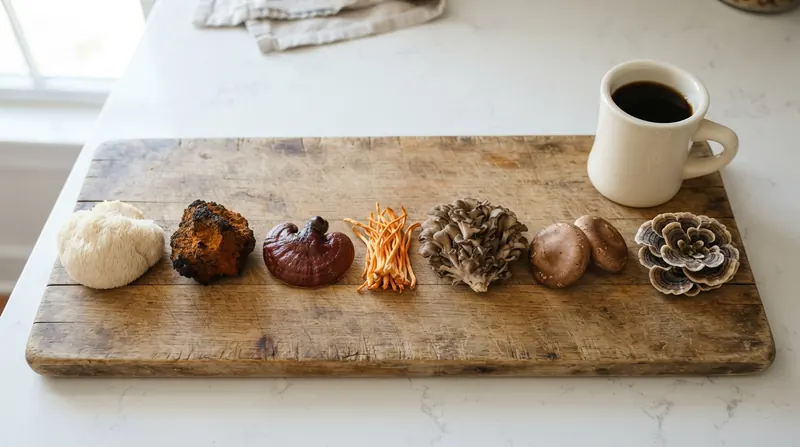
Here's the part Angela meant with her card, and it took me a week to see it. There are seven mushrooms in that pouch, and seven of us at the 7:03.
I'm not going to tell you what each mushroom does, because I've just told you I can't.
I'll tell you which one looks like which regular, which is the only thing about them I can vouch for.
Chaga is Lou. It grows on birch trees in cold country and looks like a lump of burnt bark, black outside and rusty orange inside, and it's been around longer than anybody.
Lion's mane is Sal. Shaggy and white, with long soft spines hanging down like a beard nobody's allowed to trim.
Reishi is Walt. Glossy red-brown, shiny on top like a varnished banister, and about as easy to argue with.
Cordyceps is Eddie. Thin orange stems, wiry, the kind of thing that looks like it never once sat still.
Maitake is Ray. In the woods they call it hen of the woods, a big ruffled cluster that looks like a hen fluffing her feathers over four newspapers.
Turkey tail is Marty. Thin fans with bands of brown and tan and gray, stripes like rings on a tree, like the sweater vest he's worn since the Carter administration.
And shiitake is me. The plain one, the one you'd find in any grocery store in any town in America.
I read that list out loud at the 7:03 the first week I brought the pouch.
Walt objected to being a reishi, Sal said lion's mane was the first compliment he'd had on his hair since 2009, and Lou laughed so hard Danny had to come out from the back.
That's the morning I knew I was back. I'd named all seven men, and all seven mushrooms, before the coffee finished dripping.
One Teaspoon, Six Ounces of Hot Water and a Diner Mug
So I took the pouch down to the shop.
Here's the ritual, laid out the way I'd teach a new barber to set up his station, because the ritual turned out to be most of the point.
Step one, the mug: I use a thick white diner mug with a chip on the handle that came from the Third Street Diner when it closed in 1997.
Ray rescued six of them, and they've lived on the shelf above chair No. 1 ever since.
Step two, the water:
Danny keeps an electric kettle on the counter for hot towels, and I take six ounces from it, which is about three-quarters of my mug, a little shy of the eight the panel allows.
Step three, the teaspoon: one level teaspoon from the pouch, stirred well, the way the listing says. It dissolves in about three turns of the spoon, faster than the sugar ever did.
Step four, drink it: I drink mine at 7:03, the minute Lou walks in off the bus, and I drink it slow, because there are fifty-five minutes before the first customer.
Step five, name the room: this is the step that isn't on the pouch, and it's the one that matters most to me.
Before I finish the cup, I say good morning to every man who walks in, by name, out loud, with his usual haircut and one thing I know about him.
I'll tell you about that list in a minute.
That's the whole procedure. No measuring scoops, no blender, nothing to swallow whole with a glass of water; just a mug, a teaspoon, and the corner.
The taste, since everybody asks. It tastes like a decent cup of instant coffee, and I won't dress it up any fancier than that.
It's smooth, a little earthy underneath, and less sharp on the stomach than the diner coffee I drank for twenty years.
The pouch says "Low Acid," and I'll let you be the judge of that one.
Connie tried it once and said it tasted "like coffee that went for a walk in the woods."
She meant it as a criticism, and I took it as a description, which is a fair summary of forty-one years of marriage.
Lou takes his with three sugars and says it tastes exactly like his coffee, which is because his coffee has always tasted like three sugars.
And here's the part I didn't expect: I went from five cups a day back to one, sometimes two. One mug at 7:03, and if I want another, it's before noon.
The jitters went away inside a week, my hands were steady on a neckline again, and I stopped staring at the ceiling at one in the morning. That's not the mushrooms;
that's me drinking three fewer cups of coffee, and the FDA's caffeine page would tell you the same thing. [6]
Six Things This Pouch Is Not, Tallied Before Anything Else
Before I tell you what the appointment book said after twelve weeks, I want to tally what this pouch is not.
At the shop, you tell a man what a cut won't do before you tell him what it will, so nobody walks out disappointed.
It is not medicine. It's instant coffee with mushroom extracts, sold as a food, with the standard FDA sentence at the bottom of the listing.
If your doctor has you on anything daily, the cup sits beside it, never in place of it.
That line is underlined twice in my appointment book, and it belongs underlined in yours.
It is not decaf: it's Arabica coffee, and coffee has caffeine. The listing for this pouch doesn't print a number, so I count every cup as a cup of coffee.
If caffeine keeps you up, makes your heart race or your hands shake, this is coffee and it will do what coffee does to you.
The FDA says some conditions and some medicines make people more sensitive to it, and that's worth a question to your pharmacist. [6]
It is not a pile of mushrooms. The amounts aren't printed, and the whole teaspoon weighs two grams; nobody should picture a bowl of Connie's mushroom soup in that mug.
It is not the preparation from the studies.
The Japan trial used 3.2 grams of lion's mane a day, by itself;
this is a blend in a teaspoon of coffee, and no honest comparison between them is possible. [1]
It is not something to swallow whole. There's nothing to count out of a bottle and chase with water;
it's a teaspoon stirred into a mug, which is the whole reason Angela picked it.
And it is not something to pick in the woods. Seven mushrooms in a pouch from a company is not an invitation to go find your own on a hike;
leave that to people who know exactly what they're doing.
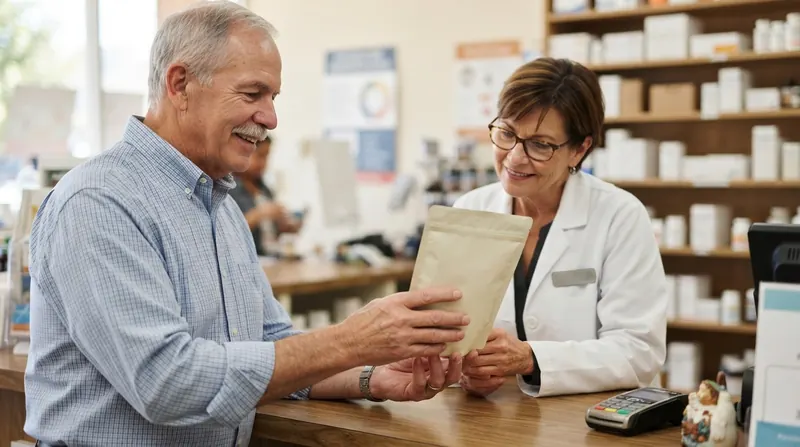
My pharmacist at the Rexall on Fourth read the back of the pouch for me in about thirty seconds. She said, "It's coffee, Vince;
count it as coffee, and tell your doctor you've switched," and that's exactly what I did.
Morning, Vince. Connie's refill is ready whenever you're by.
9:04Thanks, after the shop, around ten. I'll bring that coffee pouch my sister sent so you can read the back.
9:11Bring it. I'll check it against your list while you wait.
9:12That's why I asked. Whatever you say, I'm still not going back to five cups.
9:14Why There Are No Customer Reviews on This Page
I'm one man with one appointment book. So I went looking for what other people had said about this exact pouch, and I owe you an honest report of what I found.
On the product page itself, I couldn't find a single review of this pouch that I could read in full.
The review box was there, and it was empty of anything I could quote.
The company's home page shows a big number of reviews for the store as a whole.
I'm not going to print that number here, because it covers everything the store sells, and this column is about one pouch.
That's the same rule I used at the shop. When a man told me his brother-in-law loved his haircut, I didn't count that as a review of mine.
So you won't find star ratings or customer quotes in this column.
The comments further down are illustrative, from readers of the short version of this piece, and they say so at the top.
If you need to hear from strangers before you buy a pouch of coffee, that's a fair thing to want, and this page can't give it to you.
I'd rather tell you that plainly than borrow somebody else's stars.
What I can tell you is what a barber notices about a company when there are no reviews to read.
Does it print a phone number, does it print its terms in plain words, and does it make promises it can't keep on the label itself?
The phone number is there: (818) 305-5360, in California. The terms are there, and I'll read them to you in full further down.
The address is there too, but it's only half an address: Unit 355, Verdugo City, California 91046, with no street.
I looked for the street on every page they publish and couldn't find it, so I'm printing exactly what they print.
I wouldn't call that a dealbreaker on a $25 pouch of coffee. I'd call it a line I'd want to know about before I ordered, which is why it's here.
Twelve Weeks of the Chair List, Good Mornings and Bad
I started on Monday, January 5, the first week the shop was open full days after the holidays.
I'd like to say I started out of hope, but I started out of stubbornness, because Angela was going to ask on Sunday.
And I added one thing to the 7:03 that had nothing to do with the pouch. I started a chair list.
Every morning, with the mug in my hand, I named every man who walked in, out loud, in the order he arrived.
Name, his usual haircut, and one thing I knew about him.
"Lou, number three all over, drove the 14 for twenty-eight years." "Sal, no haircut since 2009, delivered our mail."
"Walt, nothing to cut, fire engine 6," and on around the room.
Then, at lunch, I opened Danny's appointment book and did the same for every customer on the afternoon page.
On the first Monday, I got through nineteen of twenty-four names before I had to peek at the book.
The list was not a test, and I want to be plain about that.
It was a habit, the same as the corner and the mug, and a habit you practice every morning gets easier for all kinds of reasons.
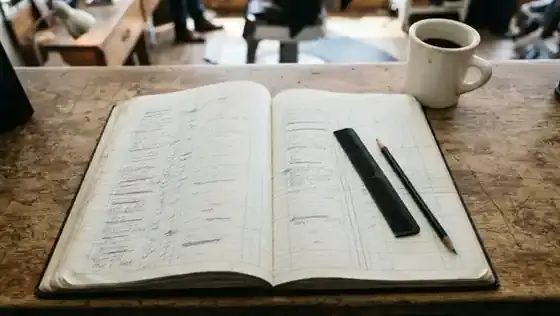
Vince's appointment book, January to March
- Week 1Mug at the 7:03 five mornings of five. Nineteen of twenty-four names before the book came out. Connie said the cup "went for a walk in the woods."
- Week 2Nothing. Same list, same misses, same mug. Wrote "nothing" four mornings running and nearly mailed the pouch back to Angela.
- Week 3First margin note: "didn't open the book until the 3:30." Back to one cup of coffee a day, two on Saturdays. Hands steady.
- Week 4Bad cold all week, stayed home three days. Mug at the kitchen table, list from the book. Lost a customer's name twice, the man with the Buick.
- Week 6Named all twenty-four three days running. Said "Morning, Gene" before Gene said a word. Walked home the long way past the river.
- Week 9Joey and the grandkids for a long weekend: no shop, no list for four days. Wrote "day off" and didn't scold myself.
- Week 12Annual checkup, with the appointment book under my arm.
I want to slow down on week two, because it's the week most people quit.
Four lines in a row that say "nothing," in the handwriting of a man who already suspected his sister had talked him into coffee that went for a walk in the woods.
What kept me going was what kept me behind the chair through every slow January for forty-six years. You don't judge a barber by his first haircut.
Week three is the margin note I'd circle. "Didn't open the book until the 3:30."
For most of the year before, I'd peek at Danny's book by the second or third name on the afternoon page.
In week three it stayed closed until the 3:30 appointment, the twentieth name on the list.
That's not a scientific measurement, and I won't let anybody quote it as one.
It's a pencil line written by a man who'd been practicing the same twenty-four names every day for three weeks, which is exactly how you'd expect a list to get easier.
Week three is also when I got back down to one cup a day.
I'll tell you honestly which of those two things I think mattered more for my hands, and it isn't the mushrooms.
Week four was the cold, and I'm printing it because an appointment book that skips the bad week isn't an appointment book.
Three days home with a box of tissues, the mug at the kitchen table, and the list from the book.
I lost the man with the Buick twice that week, a customer I've cut since 1990.
His name is Frank Kessler, and I wrote it down both times in the same size handwriting as the good days.
Week six is the one Angela asked to hear about on Sunday. Three days running, all twenty-four names, haircuts and one fact each, and the book never opened.
And on the Wednesday of that week, Gene Polaski walked into the shop for his trim. I said "Morning, Gene, number two on the sides, how's Admiral?"
before he got his jacket off.
I don't know what that's worth to anybody else. To me, it was worth the whole appointment book.
Week nine was Joey and the grandkids, up from Columbus for four days of pancakes and board games and nobody near the shop.
I wrote "day off" on each of those lines and didn't scold myself once. A good barber knows the difference between a bad cut and a Sunday.

Dad, Mom says you've been at the 7:03 every morning. Even in February?
4:22Every weekday, twenty-four names, haircuts and all. One cup of coffee now, not five.
4:31Did you tell Doctor Patel about the new coffee?
4:32Checkup is the 30th. It's written at the top of the appointment book page, so I don't forget to say it.
4:35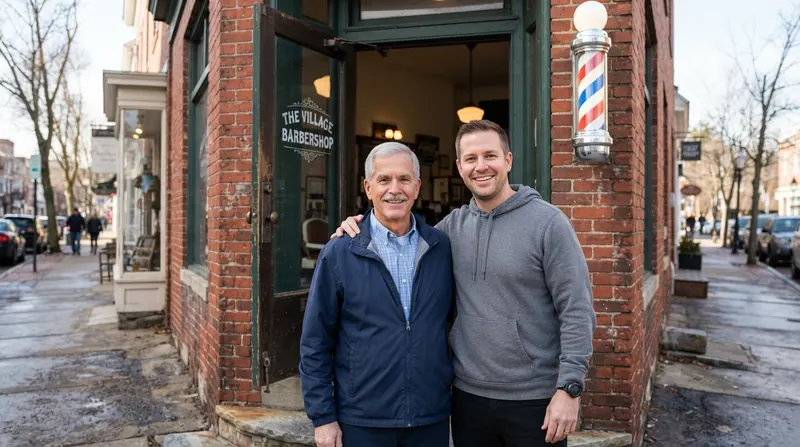
What Doctor Patel Said About Twelve Weeks of the Book
At the end of March I went to my annual checkup with the appointment book under my arm and a sharpened pencil in my shirt pocket, where the comb goes.
Doctor Patel is a careful young man who listens before he types.
I told him about Gene, the keys in the sugar canister, the comb in the mailbox, Connie's list, the five cups of coffee, and then I told him about the pouch.
He read the back of it, the way Teresa had, and asked what else I took.
Then he asked the questions he asks, wrote some things down, and said that from what he'd seen and heard that morning he had no particular concerns.
"Keep going down to that corner," he said.
"Keep the coffee at a cup or two, keep doing the crossword in pen if it makes you happy, and tell me if anything changes."
Then I handed him the appointment book, and he read three pages of it without saying a word, which in a twenty-minute appointment is a long time.
"You went to the 7:03 fifty-eight mornings," he said finally, "and you cut back from five cups to one. Those are the two lines I'd keep."
And here's the most honest sentence I can write about the pouch: I can't tell you which line did what.
In twelve weeks I walked down to the corner most mornings, practiced the same twenty-four names, went back to a room full of people, cut my coffee by four cups, and stopped finding my keys in the sugar canister.
Any one of those could be the reason the mornings felt clearer, or all of them together, or simply a good winter.
What I can tell you is the order: the pouch didn't walk me to the corner; the corner is what I walked to.
Angela wrote that after I read her the numbers over the phone and she made me mail her the pages. I hadn't counted;
Angela counts everything, including the number of times I said "chief" in November, which she got out of Danny, and which was eleven.
And notice the order she put it in: the corner, the 7:03, the checkups. The coffee comes along; it never sits in the chair.
Where the Mug Actually Fits in a Day
People ask what a day looks like now, as if there were some grand new routine. There isn't, and that's the point.
6:15 a.m. Up, dressed, comb in the left shirt pocket, and I pat the pocket before I leave the bedroom, which Connie finds very funny.
Then the keys, which go on the brass hook by the back door. I say "hook" out loud when I hang them, which Connie finds even funnier.
6:45 a.m. The walk to the corner, nineteen minutes, past the church, the hardware store and the house with the three-legged cat on the porch.
7:03 a.m. Lou off the bus, the mug, one teaspoon in six ounces from Danny's kettle, and the chair list out loud, one man at a time, as they come in.

8:00 a.m. Danny flips the sign, the fellas head out, and on Saturdays I pick up a comb at chair No. 2 for four hours.
Sunday, 4:00 p.m. Angela on the phone, one o'clock her time, and she asks about the list before she asks about my knee.
Evening. The crossword in pen, a page of the paper, and no coffee after noon, which is a rule I wrote for myself, not one printed on the pouch.
That's why I trust it, honestly.
A habit that asks for a teaspoon, a mug I already own and a corner I already love is a habit I'll still be keeping in October.
The cartoon fox asked for my attention every hour and lasted seven weeks. The five cups asked for my hands and my nights and lasted a month;
the corner asks for nineteen minutes of walking, and it's lasted ten months.
How to Keep a Chair List Like a Barber
More readers have asked me about the list than about the pouch. So here's the method, exactly as I keep it, and it works with or without anything in the mug.
Pick a room you already go to.
A coffee counter, a church hall, a bowling alley, the bench outside the post office, anywhere a dozen people show up who you'd like to greet by name.
Greet them out loud, by name, as they walk in.
Saying a name is a different job from thinking it, and it's the job we fumble at the hardware store, so practice that one.
Add the haircut, though it doesn't have to be a haircut; it's whatever you notice first, the hat, the cane, the dog.
"Sal, white mane, never cut," gives the name something to hang on, like a key on a hook.
Add one fact: the job he retired from, his wife's name, his team.
A name with two things hanging on it is a lot harder to drop than a name standing by itself.
Write down where you stalled, not just how far you got. "Lost the man with the Buick" is an entry;
"bad morning" is a feeling, and feelings don't add up at the end of the month.
Write the bad mornings in the same size handwriting as the good ones.
That's the rule most people break, and it's the rule that makes the book worth carrying.
Take it to your checkups: Doctor Patel read three pages in March, and he said it told him more about my mornings than any question he could have asked in twenty minutes.
That last rule is the reason I'd keep the book even if Angela had never mailed me a thing.
Twenty minutes goes a lot further when you walk in with twelve weeks of pencil.
What Readers Wrote When This Ran as a Short Column
A shorter version of this column ran in the spring. The comments were better than the column, which is usually how it goes.
The comments below are illustrative, retold from reader notes with names shortened. Replies sit indented under the comment they answer, and they're here because they ask what you're probably asking.
Carol's comment is the one I've thought about most. "Blamed his hearing."
I did the same thing with the 7:03 and my knee.
We invent a respectable reason, because the real one feels like a confession, and a confession at our age feels like a verdict.
And Helen's comment is the reason I'd print the caffeine paragraph again tomorrow, in bigger type. Mushroom coffee is coffee;
whatever you try, take the pouch to your pharmacist first and say the name of everything else you take out loud.
Angela and I, Recorded for the Neighborhood Radio Show
In September, when Angela flew out for a week, the little neighborhood radio station on Fifth asked whether we'd sit for its Sunday "Corner Hour," the show where two old-timers talk about the neighborhood.
Angela said yes before I could say no.
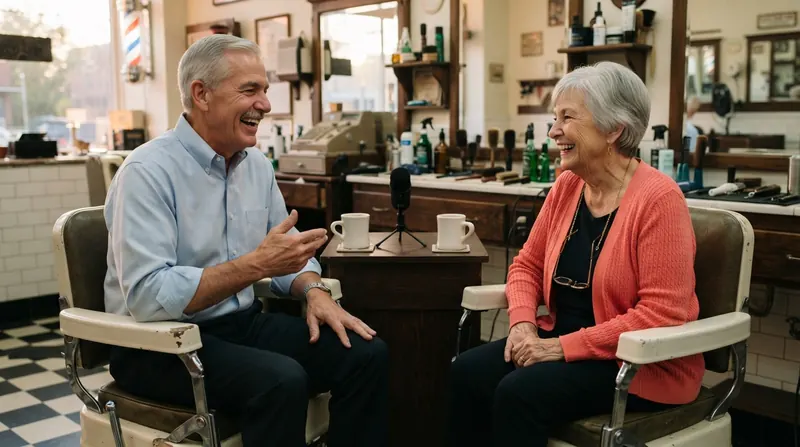
We recorded it in the shop, after closing, in chairs No. 1 and No. 2, with a microphone on the counter between us.
Here's the transcript, trimmed only for the part where Lou knocked on the window to say hello.
The Corner Hour · Sunday Tapes, No. 9
A Barber, a Lunch Lady and the Seven Men at 7:03
Vince
host
Angela, the station wants to know why a school cafeteria manager mailed a pouch of coffee to a barber in Pennsylvania.
 Angela
guest
Because you'd stopped going to the 7:03, and you're the only man on that corner who knows everybody's name. I wanted you back where you belong, and a pie doesn't fit in a padded envelope.
Vince
host
And why coffee? I already drank five cups a day.
Angela
guest
That's exactly why: thirty-one years in a cafeteria taught me you never add a new food to a tray; you change what's already on it. You were drinking coffee anyway, so I sent coffee, and a card that said one cup, not five.
Vince
host
I looked it all up, you know, the way you told me to. The one mushroom with studies used more lion's mane in a day than there is in a whole teaspoon of the stuff, and the other six had nothing I could find.
Angela
guest
I never told you it was in a study. I told you to read the back before you believed me, and you did, which is more than most of my fourth-graders ever did with a milk carton.
Vince
host
Fair enough. So tell the neighborhood the honest version: what does the pouch do?
Angela
guest
It's a decent cup of coffee at about seventy cents a mug. For twelve weeks it sat in your hand at 7:03 while you named twenty-four men out loud and cut back to one cup, and whatever your mornings feel like now, you earned most of it walking to this corner.
Vince
host
And what would you tell somebody standing behind their own chair right now, waiting for the name of a man they've known thirty years?
Angela
guest
Go back to wherever you stopped going, and say everybody's name out loud when you get there. And if you take anything every day, show the pouch to your pharmacist first, because coffee is coffee.
Angela listened to the recording afterward and asked for one correction.
She wanted it on the record that she has never once called herself a "lunch lady," and that the tater tots were baked.
I've gone back to that last line of hers more than any other. "Go back to wherever you stopped going."
35-serving instant pouch · one teaspoon a cup · read the return terms before ordering
The Return Terms, Read Like a Shop Lease
Now the part most columns skip, and the part I read first on every lease I signed for that corner: what happens if you don't like it.
I want to be very plain here, because this is where a lot of companies get slippery.
The seller's "Store Policies" page puts a big guarantee in its title, and then the sentence underneath says something more specific, so I'll give you the sentence.
Returns and exchanges within 30 days. That's the headline of the policy, word for word: the company "accepts returns and exchanges within 30 days."
If they make a mistake, the page says they'll resend the correct order at no charge and pay for any return shipping needed.
If you change your mind, the page says they're "happy to refund your order when the unopened item is received."
Read that last line twice, the way I did: "unopened." A pouch you've opened and tried, and didn't care for, isn't covered by that sentence as written.
That's not a scandal; it's coffee, and plenty of food companies work that way.
But a full guarantee in the title and "unopened" in the sentence are two different promises, and you deserve to know which one is in the fine print.
Here's what I'd actually do, as a man who spent forty-six years telling customers to try a little off the sides before they shave the whole thing.
Order one pouch, $24.99, thirty-five cups.
Thirty-five cups is five weeks at one a day.
That's enough to find out whether you like the taste, and whether a mug at the same hour every morning fits into your life.
The company is La Republica Superfoods, and it prints Unit 355, Verdugo City, California, without a street. It publishes a phone line, (818) 305-5360, and an email, help@larepublicasuperfoods.com.
A phone number, an email, and return terms with real words in them, plus half an address.
My checklist for any supplier who wanted to sell me shampoo was three lines long, and this pouch ticked two and a half of them.
Shipping, for the record:
the policies page says orders go out within 24 hours, Monday through Saturday, by USPS or UPS, and that the company does not ship to Mexico, Central America, Asia or most of the Middle East.
Ten Letters That Came to the Shop
After the short column ran, I got more letters than I've had since the shop's twenty-fifth anniversary. I've answered the ten that asked what most of the others asked.
The letters below are illustrative composites, retold from reader notes with names shortened. The answers are mine, the same ones I'd give from chair No. 2.
Short answers to the questions I get at the shop
How do you make it?
One teaspoon in 6 to 8 ounces of hot water, stirred well, per the listing; the panel says one teaspoon makes 8 fluid ounces. I use six ounces in a diner mug, at 7:03, and milk or sugar is up to you.
What does it taste like?
Like a decent cup of instant coffee, smooth and a little earthy. My wife says it tastes like coffee that went for a walk in the woods; my friend Lou takes three sugars and says it tastes like his coffee.
Does it have caffeine?
Yes, it's Arabica coffee. The listing for this pouch doesn't print a caffeine number, so count each cup as a cup of coffee; the FDA cites 400 mg a day as an amount not generally linked to negative effects in most healthy adults.
How much lion's mane is in a cup?
The label doesn't say: the whole teaspoon weighs 2 grams, coffee included, and the seven mushrooms aren't itemized. The Japan trial used 3.2 grams of lion's mane a day, so no honest comparison is possible.
How long does a pouch last?
35 servings: five weeks at one cup a day, two and a half weeks at two. At $24.99, that's about 71 cents a cup, not the 60 cents printed on the listing.
Will it bring the names back?
Honest people can't promise that, and the listing carries the FDA statement saying its claims haven't been evaluated. The mushroom research is small and used much bigger amounts, and this pouch hasn't been studied on its own.
Can I drink it if I take something daily?
Ask first. It's coffee, and the FDA says some conditions and some medicines make people more sensitive to caffeine; take the pouch to your pharmacist and tell your doctor you've switched.
Is it organic?
The pouch shows the USDA Organic seal, and the ingredient line lists both the Arabica coffee and the mushroom extracts as USDA Organic.
Who makes it, and how do I reach them?
La Republica Superfoods, Unit 355, Verdugo City, California 91046; the company doesn't publish a street. Phone (818) 305-5360; email help@larepublicasuperfoods.com.
What if I don't like it?
Returns and exchanges within 30 days; their mistakes are resent at no charge, and a change-of-mind refund applies once the unopened item is received back.
Who This Pouch Is For, and Who Should Pass
I wouldn't send a man out of the chair without a mirror, so here's mine. Fair notice: half of it tells some of you not to buy.
It probably makes sense to look at it if:
- You already drink coffee every morning and would rather change the cup than add something new to swallow
- You'd rather read two lines on the back than a blend of eleven things you need a dictionary for
- You like the idea of one mug at the same hour, in a place where people know your name
- You can count each cup as a cup of coffee, and your pharmacist has already looked at the pouch
- You'll keep a list or a notebook and take it to your next checkup
It probably isn't for you if:
- You want a promise about names, keys or lists; the research is small, used far larger amounts, and the listing's FDA line says so
- You're avoiding caffeine for any reason; this is real coffee, and the listing doesn't print the caffeine number
- You want to know exactly how much of each mushroom you're getting; the label doesn't itemize them
- You need customer reviews before buying; this pouch had none I could read in full
- You're expecting or nursing; take any new food or drink with caffeine to your doctor first
That first line on the second list matters most.
This is a teaspoon of coffee in a mug, not a plan; the plan is whatever you and your doctor write down together.
What a Cup Costs, Done in Pencil Instead of Copied
Now the money, because Angela made me promise I'd put it in black and white. The pouch is $24.99 for thirty-five servings.
The listing says that works out to "about $0.60 per serving." I did it in pencil at chair No. 1, twice, and got a different number both times, the same different number.
$24.99 divided by thirty-five is seventy-one cents a cup. Not sixty.
Eleven cents isn't going to ruin anybody.
But a company that can't divide its own price by its own serving count on its own page has told me something, and I'd rather you heard it from me than discovered it with a calculator.
I'm not saying the $80 was wasted because the cup is cheaper.
I'm saying the $80 was aimed at my kitchen table, and the seventy-one cents comes with a walk to the corner and seven men who know my name.
For comparison, a cup at the diner on Third used to be a dollar and a quarter with refills, back when there was a diner on Third.
Angela says that number proves only that I'm old.
Where the Pouch Stands, Line by Line
Here's the summary I'd tape to the mirror at chair No. 2. If you only remember one part of this column, make it this one.
✓ Two lines on the label, organic Arabica coffee and seven organic mushroom extracts, with a plain Nutrition Facts panel: one teaspoon, two grams, seven calories.
✓ About 71 cents a cup, done in pencil, with one pouch as the cheapest way to find out whether you like it, and a California phone line and email on the seller's pages.
✓ A habit that fits a morning you already have: a mug, a teaspoon, six ounces of hot water, nothing to swallow whole and nothing new on the tray.
✓ The best-studied ingredient in the cup is the coffee, with real research on alertness and clear federal numbers on how much is enough. [3] [6]
✗ The mushroom research is thin. Lion's mane has two small studies at 3.2 grams a day and 1.8 grams once, more than a whole teaspoon of this blend weighs;
the other six have nothing I could check on this question. [1] [2]
✗ No amounts per mushroom and no caffeine number on the listing, so you can't know what's in each cup beyond "coffee and seven extracts."
✗ No customer reviews of this pouch that I could read in full, and a company address with no street.
✗ A guarantee in the policy title whose change-of-mind refund covers an unopened item, and a per-cup price on the listing that the arithmetic doesn't support.
If You're Standing Behind Your Own Chair, Waiting for a Name
I can't tell you what to do.
I can tell you what I'd do if I were reading this column instead of writing it, back last October with a comb in my hand and Gene Polaski in my chair.
First, before you buy anything at all: find a room you already go to, and start a list. The coffee counter, the church hall, the bus stop, anything with names.
Second: go back to wherever you stopped going. The breakfast, the coffee, the league, the pew, whatever it was you quietly dropped because of the names.
Third: tell your doctor what you've noticed at your next checkup, and bring the list. That's the line Doctor Patel cared about most, and it costs nothing.
And fourth, if you'd like to change what's in your mug and your pharmacist has looked at your list: read the label I've been describing for ten thousand words.
Coffee and seven mushrooms, one teaspoon in six to eight ounces, about 71 cents a cup.
I won't pretend a link at the bottom of a barbershop column is anything but a door to the seller's shop. Seventh & Third Coffee doesn't keep inventory;
we keep the coffee on at 7:03.
But if you walk through that door, you'll know exactly what's on the other side:
a pouch of instant coffee, two lines on the back, return terms you've now read, half an address and a California phone line.
Organic instant mushroom coffee · coffee and seven mushrooms on the label · start with one pouch if you're unsure
One more thing, and then I'll let you get to your own morning. The appointment book is still on the counter by chair No. 1, and the 7:03 is still on time.
Yesterday's line reads: "Oct 25. Corner 7:03, one mug.
Twenty-four of twenty-four. Gene in for his trim, said his name before he sat down.
Lou says the bus was a minute late. Angela Sunday, my turn to call."
Twenty-four of twenty-four.
Four words, in pencil, written by a man who once stood a full minute behind his own chair waiting for the name of a man he'd known for thirty years.
P.S. Angela's appointment card is taped to the mirror at chair No. 2 now, faded from blue to the color of old newspaper, and if you have an Angela in your life, call her on Sunday; if you are the Angela, mail the envelope anyway.
P.P.S. Remember the order Angela wrote in the back of the book, the corner, the 7:03, the checkups: the coffee is the smallest of the four, and it's the only one that comes in a pouch.
The full ingredient guide, with a note on the coffee, the seven mushroom extracts and on reading the advertising around this pouch, is linked at the foot of this page.
First, the people: Vince Amato is a pen name. Angela, Connie, Danny, the regulars and the shop on the corner are composites, the way neighborhood columns have always been written.
Everything about the pouch itself, its label, its price, its directions and its return terms, comes from the seller's own pages, read in October 2026.